
Match TennisCast
WTN – World Tennis Number Explained
The ITF Global Standard for Player Ratings
Discover how the World Tennis Number works, what the Confidence Level means, and how to use the Game zONe to find competitive matches. Learn why over 135 nations have adopted this global rating system powered by the International Tennis Federation.
Listen Now
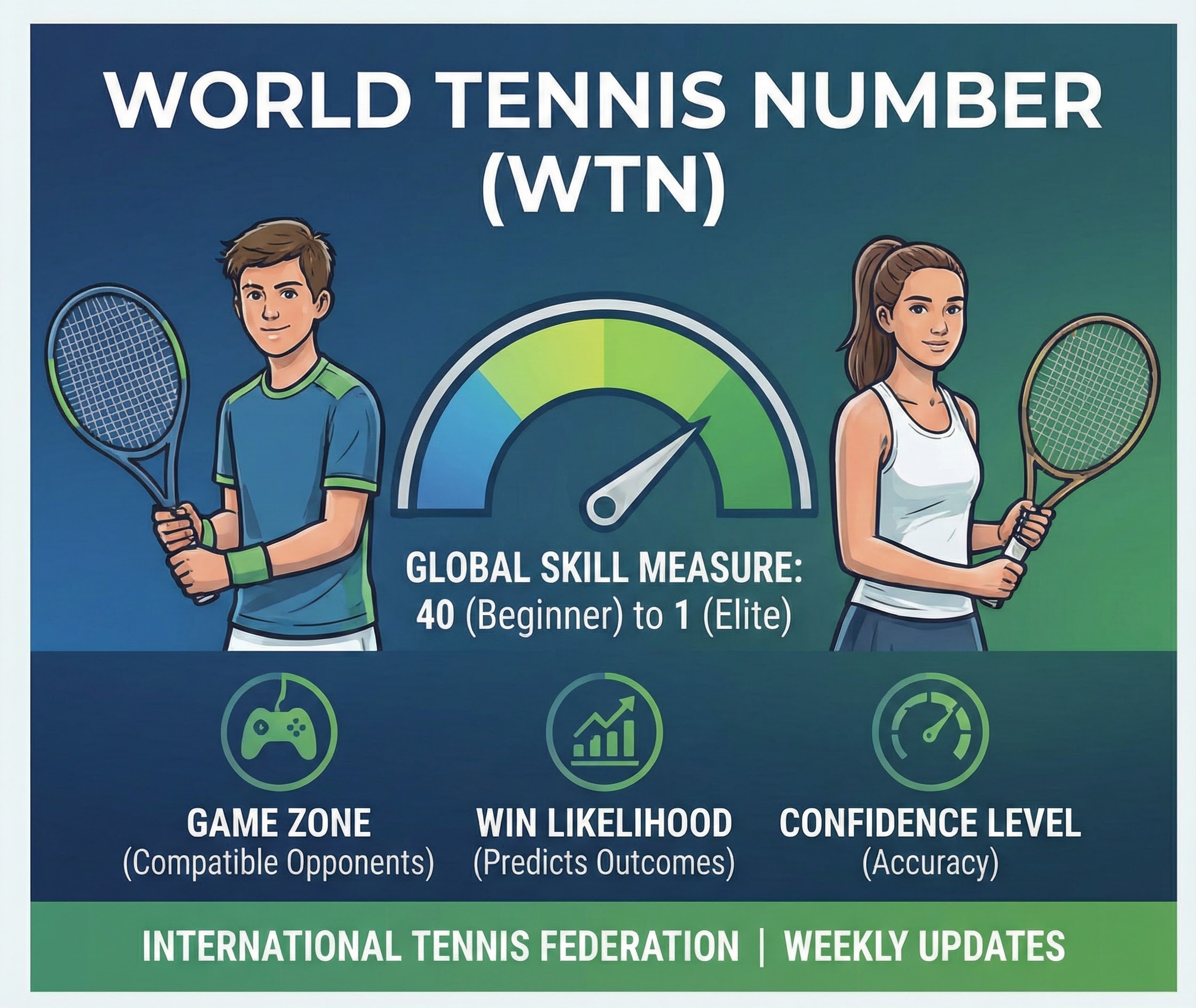
The WTN Rating Scale
A universal scale for all players worldwide
World Tennis Number Scale
40 to 1
A beginner player starts near 40, while an elite professional player will be closer to 1. The scale is universal, encompassing all players regardless of age, gender, or ability. Players receive separate WTN ratings for singles and doubles, with ratings updated weekly every Wednesday.
Key Insights
Understanding the fundamentals of the World Tennis Number
ITF Powered Rating
The World Tennis Number is created and powered by the International Tennis Federation, the world’s largest governing body for tennis. It has been adopted by over 135 nations, including the USTA, and serves over 2.2 million registered players.
Set Level Analysis
The algorithm analyzes results at the set level, treating each individual set as a distinct data point. It uses match data from 2016 onwards to predict outcomes and updates ratings based on how actual performance compares to predictions.
Performance Based Updates
A player’s WTN can improve even in a loss or decline even in a win, depending entirely on whether they exceeded or fell short of the algorithm’s expectations. This dynamic system rewards competitive play regardless of the final outcome.
Singles vs. Doubles
Singles and doubles WTN ratings are calculated using completely separate algorithms. Singles results do not influence doubles ratings and vice versa. It is common for a player’s ratings to differ by more than 1.0 between formats.
Confidence Level
Understanding the accuracy indicator of your WTN rating
Blue Checkmark (Verified)
Indicates a high level of confidence in the rating’s accuracy. Achieved by playing 15 completed sets within a 5 consecutive week period.
Grey Checkmark
Indicates a lower level of confidence. Players with lower confidence will experience larger rating changes as the algorithm calibrates their position.
The Game zONe
Your personalized range for finding competitive matches
35% to 65%
Win Probability Range
WTN 10+
Eligibility Threshold
The Game zONe identifies opponents against whom you have a probability of winning between 35% and 65%. Competing in and winning matches against opponents within your Game zONe is the fastest way to improve your WTN.
How to Improve Your WTN
Strategies for improving your World Tennis Number
Exceed Expectations
The fundamental way to improve your WTN is to consistently play better than the algorithm predicts. Win more sets or games than expected based on the rating difference between you and your opponent.
Play Competitive Matches
Winning sets against opponents with a similar or better WTN will generally improve your rating. The better the opponent, the greater the potential impact of a positive result.
Stay Active
Regular play is essential to see consistent, weekly improvements in your rating. Playing a match every two weeks is sufficient to prevent your Confidence Level from decreasing.
Understand Score Impact
Because the algorithm is set based, the exact score of a match is crucial. Winning in straight sets versus three sets can make a significant difference in how your rating is adjusted.
Monitor Weekly Updates
Ratings are recalculated every Wednesday. Your WTN can change even without recent play when new historic match data is added or the algorithm is updated for improved accuracy.
WTN Platform Features
Tools available on worldtennisnumber.com
| Feature | Description |
|---|---|
| Player Search | Search a database of over 2 million players, view their singles and doubles WTN, and see if their rating is verified. |
| Game zONe | Identifies a personalized range of potential opponents whose WTNs are close to yours, facilitating competitive matchmaking. |
| Watchlists | Follow friends and opponents from anywhere in the world to monitor their progress and compare it to your own. |
| Head to Heads | Analyze ratings, WTN history, match history, and common competitors between any two player profiles. |
| Win Likelihood | Predicts your percentage chance of winning a match against any other searchable player. |
Understanding WTN Fluctuations
Why your rating may change in unexpected ways
Winning But Rating Worsens
If you win a match but your performance (such as winning in three sets) does not meet the algorithm’s projection (such as a dominant two set victory), your WTN may go down.
Losing But Rating Improves
If you lose a match but perform better than expected (such as winning a set against a much higher rated opponent), your WTN may go up. The algorithm rewards exceeding expectations.
Listen to the Full Episode
Get the complete breakdown of the World Tennis Number system and how to use it strategically