
Match TennisCast
Decoding the Universal Tennis Rating (UTR)
The Gold Standard for Tennis Player Evaluation
Understand how the UTR algorithm works, what factors influence your rating, and how to strategically improve your score. Learn why college coaches, tournament directors, and tennis analysts rely on UTR as the most accurate measure of tennis ability.
Listen Now
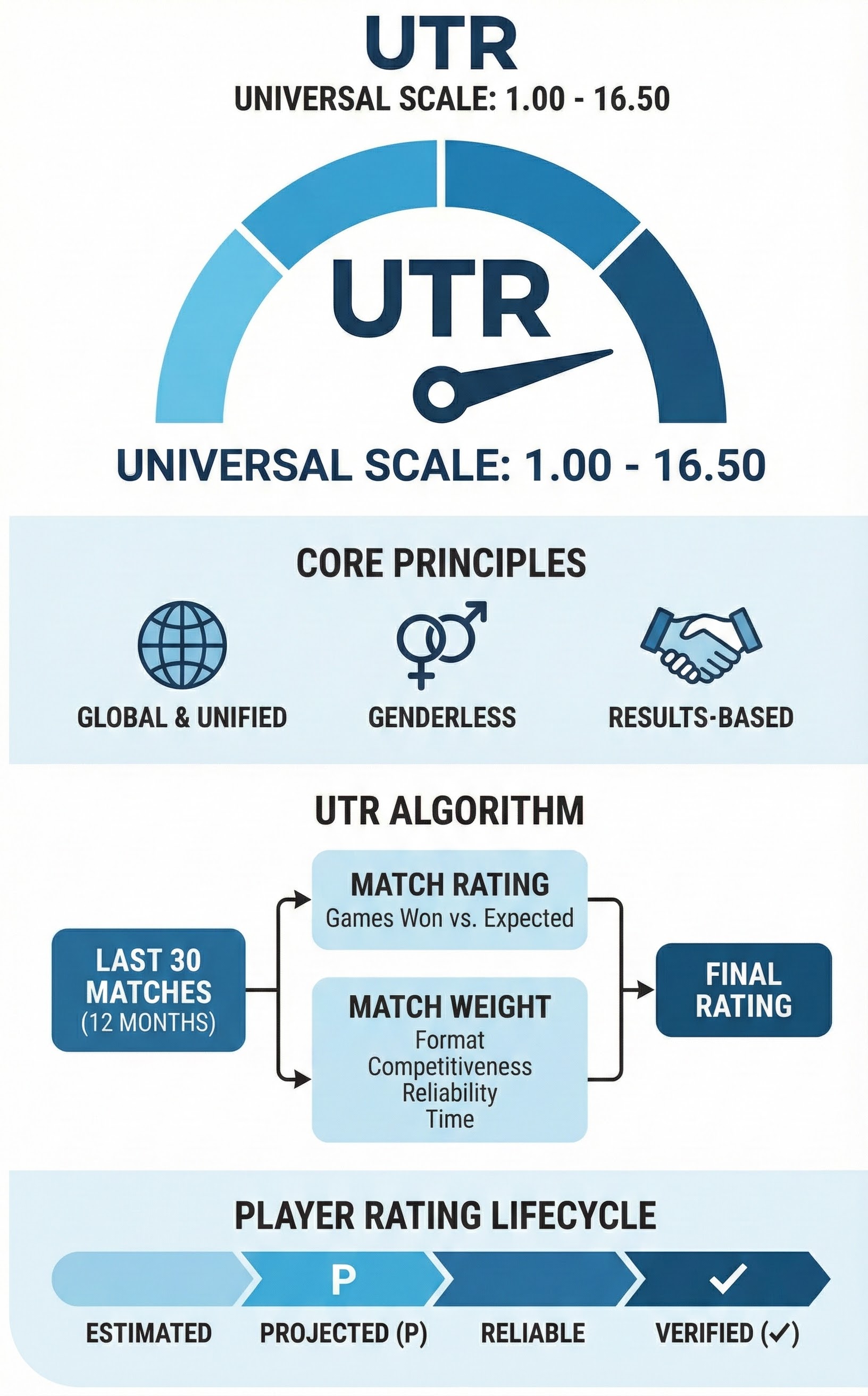
The Universal Scale
One unified rating system for all tennis players worldwide
UTR Rating Scale
1.00 to 16.50
All players are rated on the same scale regardless of age, gender, geography, or socioeconomic status. The UTR algorithm calculates a player’s rating as a weighted average of their last 30 eligible matches within a 12 month window, recalculating daily.
Key Insights
Understanding the fundamentals of the UTR system
Modified Elo System
UTR uses a modified Elo rating system that evaluates performance based on outcomes relative to an opponent’s strength. It is based solely on actual match results, not demographic factors like age, gender, or nationality.
Match Rating Component
For each match, the algorithm compares your actual percentage of games won against an expected percentage based on the UTR difference between you and your opponent. Outperform expectations and your rating increases.
Match Weight Factors
Match weight is influenced by four factors: match format (longer matches count more), competitiveness (closer ratings get more weight), opponent reliability, and time degradation (recent matches matter more).
College Recruiting Standard
UTR is widely used by college coaches, tournament directors, and tennis analysts for recruitment, event entry, and player evaluations. It is endorsed as the “gold standard” for evaluating tennis ability.
Match Weight Factors
What determines how much each match impacts your rating
| Factor | Description |
|---|---|
| Format | Longer match formats are given more weight. A best of three set match receives more weight than an eight game pro set. |
| Competitiveness | Matches against opponents with a closer UTR Rating receive more weight. For a 6.00 player, a match against a 5.00 or 7.00 is weighted more than against a 4.00 or 8.00. |
| Reliability | Matches against opponents with a reliable UTR (those who compete often) are given more weight. |
| Time Degradation | More recent matches receive more weight to reflect a player’s current form. Matches played within the last few months get more credit. |
Rating Types and Progression
How players progress through the UTR rating lifecycle
How to Improve Your UTR
Strategic tips for managing and improving your rating
Play Well, Not Just Win
The most direct method is to perform well by winning more games than the algorithm expects. Compete for every game, even in a losing effort, as close losses against higher rated players can actually help your rating.
Play Often and Against Variety
Competing frequently against a variety of opponents, both higher and lower rated, ensures your rating accurately reflects your current form and skill level.
Be Patient with Results
Since UTR is a rolling weighted average of up to 30 matches, the impact of new results can be slightly lagged. A single result may not cause an immediate dramatic shift.
Understand Opponent Impact
A loss to a higher rated player is not necessarily detrimental if you win more games than expected. However, playing close matches against lower rated opponents can decrease your rating.
Monitor Rating Fluctuations
Your rating can change without playing due to daily recalculations, changes in opponents’ ratings, or older matches expiring from your 12 month window.
“The UTR Rating is the best way to measure yourself against all other players regardless of their age or level.”
UTR Key Attributes
The core value proposition of the Universal Tennis Rating
Accuracy
Positioned as the most precise measure of a player’s current skill level.
Inclusivity
Every player can obtain a rating, breaking down barriers of age, gender, or location.
Access
Provides entry into the UTR Sports network to find local events and opponents.
Analysis
Allows players to track progress and analyze performance over time.
Listen to the Full Episode
Get the complete breakdown of the Universal Tennis Rating system and how to use it strategically